The exposure triangle in photography combines aperture, shutter speed, and ISO to control the final exposure of an image. Understanding how these elements interact is crucial for mastering control over your digital camera. Aperture determines the amount of light and depth of field, shutter speed controls motion and blur, and ISO affects sensitivity and noise. Balancing these elements is essential for achieving the desired look in your image.
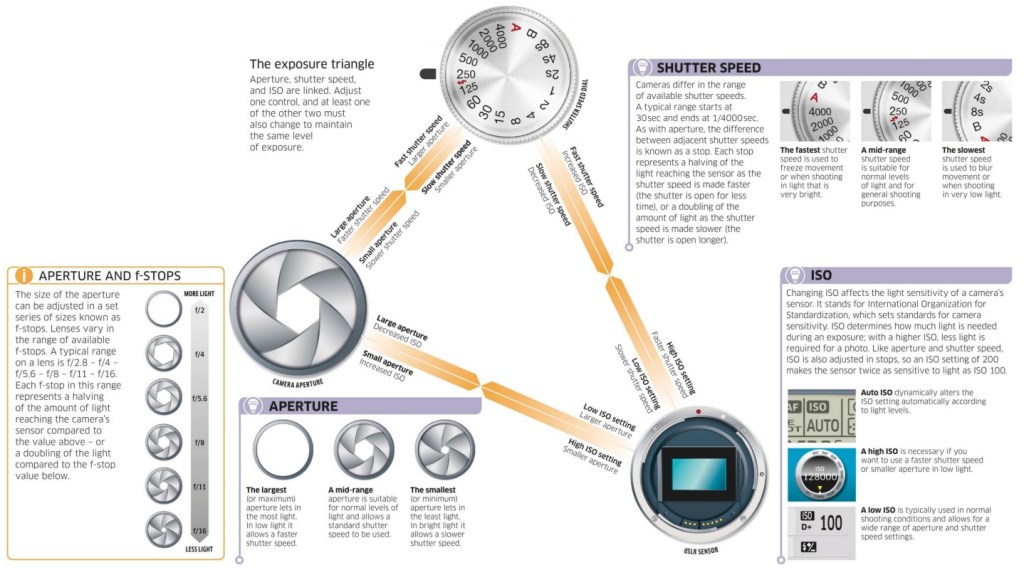
The exposure triangle is a fundamental concept in photography that combines three essential elements: aperture, shutter speed, and ISO. These three elements work together to create the final exposure of your image. Understanding how these elements interact is key to mastering control over your digital camera.
Aperture
The aperture is the size of the opening within your lens that allows light to pass through to the sensor. Aperture is measured in f-stops, with a lower f-stop indicating a larger aperture and a higher f-stop indicating a smaller one. A larger aperture lets in more light, but it also creates a shallower depth of field, which can be used creatively to isolate your subject from the background.
Shutter Speed
Shutter speed is the length of time that your camera’s sensor is exposed to light. It’s measured in seconds or fractions of a second. A fast shutter speed (like 1/2000) can freeze motion, while a slow shutter speed (like 1/30) can create a sense of movement or blur.
ISO
ISO is the sensitivity of your camera’s sensor to light. A lower ISO (like 100) means less sensitivity and less noise, while a higher ISO (like 3200) means more sensitivity and more noise. It’s generally best to use the lowest ISO you can while still achieving a proper exposure.
Mastering the exposure triangle is a process of balancing these three elements to achieve the desired look in your image. It’s a fundamental part of photography and a key element in taking control of your digital camera.
Summary Settings
The table below shows some example settings for the exposure triangle that give you some indication of the relationships between Aperture, Shutter Speed and ISO. This is only a guide, use these as a baseline and experiment, the rule is use what works best for you.
| Scene | Aperture | Shutter Speed (Secs) | ISO |
| Portrait | f/2.8 | 1/200 | 100 |
| Landscape | f/16 | 1/100 | 100 |
| Sports | f/5.6 | 1/1000 | 400 |
| Night Sky | f/2.8 | 20 | 1600 |
| Indoor | f/4 | 1/10 | 800 |


 Kemple Photography Blog
Leave a Reply