Welcome to my first blog entry and a dive into the intricate process of how a camera “sees” and captures images. Here we will explore the mechanics of digital sensors, light conversion, and the role of camera components such as the lens, aperture, and shutter play in capturing images. By understanding these elements, we can appreciate the complex symphony of light and technology that allows us to freeze moments in time.
Digital Sensor
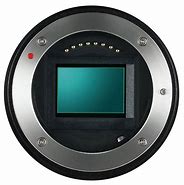
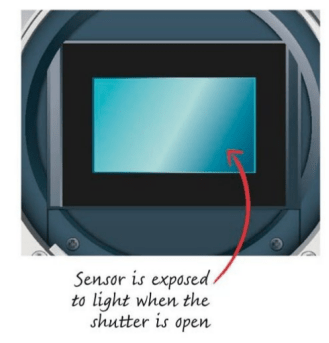
Every digital camera contains a light-sensitive surface known as the digital sensor. When you press the shutter button to take a photo, this sensor collects and records the precise amount of light that hits it. The camera then converts this information into data used to construct a digital image.

The digital sensor contains millions of microscopic cavities known as photosites. When the sensor is exposed to light, particles of light (photons) fall into the photosites. After the exposure ends, the camera counts the number of photons in each photosite and uses this information to construct a photo. The darkest areas of an image have the fewest photons, while conversely, the brighter areas have a higher photon count.
Converting Light
To create a sharp photo, light must be precisely focused onto the sensor using a camera lens. There are various lenses for different types of photography, which I will discuss in another entry. The amount of light reaching the digital sensor is controlled by two mechanisms.
The first mechanism is called the aperture, which refers to the iris within the lens. The second mechanism is the shutter, a curtain that sits directly in front of the digital sensor. These two controls regulate the flow of photons reaching the photosites sensor, much like a tap controlling the flow of water.
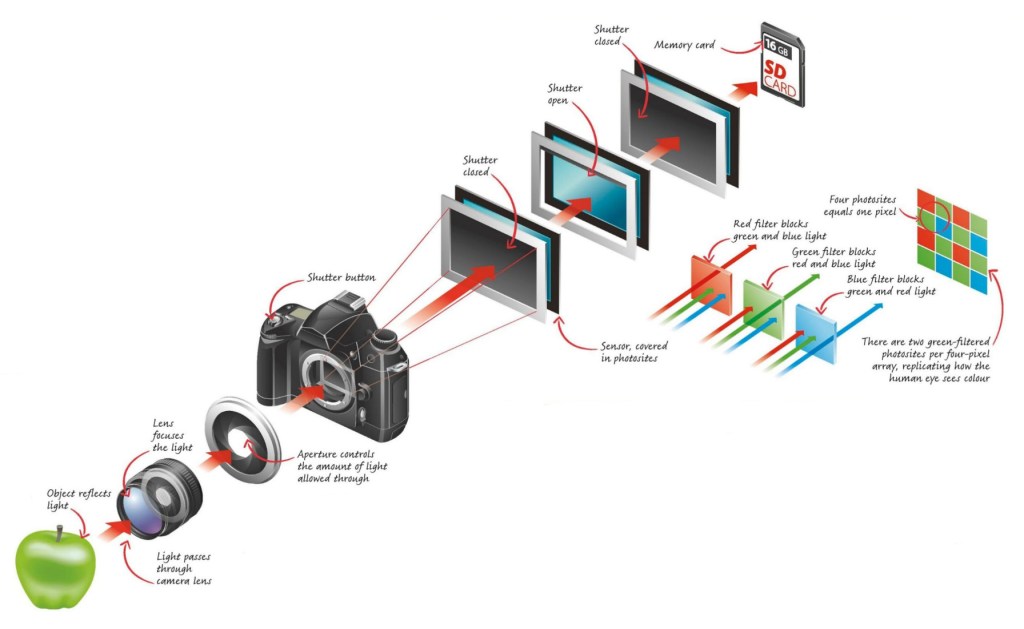
Above is an image illustrating how a camera captures and processes an object’s image, storing the data onto an SD card. First, an object is captured with light reflecting off it. The lens focuses the subject and allows light to pass through the aperture. This light then passes through the shutter, which, when open, allows light to reach the digital sensor. Here, photosites collect the photons.
Each photosite only records levels of brightness. To record color, a filter (red, green, or blue) is placed over each photosite. This filter blocks light of similar colors. A cluster of one red, two green, and one blue photosite is combined by the camera to make up one pixel in the final photo.



 Kemple Photography Blog
Leave a Reply